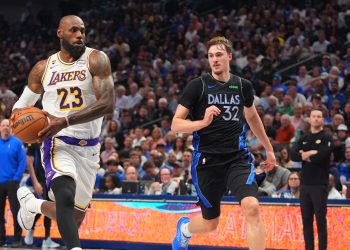
For the second-straight year and third of the past four, the NBA Finals features neither of the stars whose presence defined the event in the 2010s, LeBron James and Stephen Curry. After four straight years of Curry’s Warriors facing off with James’ Cavaliers — which followed two straight years of James’ Heat facing the San Antonio Spurs — the NBA has its sixth-different Finals matchup in as many years as the Mavericks face the Celtics.
It is no secret that NBA Finals ratings have fallen off since the last James-Curry matchup in 2018. The Warriors’ six-game loss to Toronto in 2019 was, at the time, the least-watched Finals in a decade — and its audience of 15.1 million looks positively gaudy compared to the years that followed. The COVID-delayed Finals of 2020 and 2021 averaged just 7.7 and 10.2 million viewers respectively, and the recovery since those days has been modest: 12.4 million for an ostensibly marquee Warriors-Celtics series in 2022 and 11.6 million for the Nuggets’ lopsided matchup with the Heat last year.
In the current television environment, 11-12 million viewers is respectable — even good — but for the NBA Finals such figures have traditionally qualified as mediocre.
To be sure, the NBA has not suffered any consequence from the drop-off in viewership. To the contrary, the league is on the cusp of a media rights deal that is expected to bring in $76 billion over 11 years and $7 billion annually. Keeping exclusive rights to the Finals was a top priority for ESPN in its negotiations on a new deal, which at $2.6-$2.8 billion/year will double parent company Disney’s current rights fee. The Finals, even with its diminished viewership, is as valuable now as it ever was.
Yet even if the NBA has 76 billion reasons not to sweat the ratings, the league and its many outside observers are cognizant of the sports television pecking order. A few years ago, some particularly optimistic prognosticators argued that the NBA was gaining on the NFL. The NBA had its three most-watched Finals since 1998 from 2015-17, the same period of time that the NFL was suffering through its much-discussed — and since memory-holed — ratings panic. The NBA was of course never going to catch the NFL, but the suggestion has been mined for mockery in the years since, as the NBA audience has waned and the NFL has grown and grown and grown.
There is no shame in losing to the NFL, but in the past five years the Finals has failed to hit the high notes that even other, less formidable properties have reached. The most-watched Finals game since 2019 was Warriors-Celtics Game 6 at just shy of 14 million (13.99M). [Related: NBA Finals ratings history.] The NCAA men’s basketball national championship has hit or approached record-lows since returning from its 2020 cancellation, but all four title games — plus a handful in earlier rounds — have surpassed that mark. Thanks to Caitlin Clark, this year’s NCAA women’s basketball title game averaged more viewers than any men’s basketball game since 2019 and any NBA game since 2018.
Those aforementioned events are single-elimination, which will understandably have an advantage over a seven-game series. Yet even the World Series — which last season fell below even the COVID-era lows of 2020 — has gotten back to the 14 million mark more recently than the NBA, as 14.1 million tuned in for Game 6 of Braves-Astros in 2021.
Will this be the year that Finals viewership returns to form? On paper, the Mavericks-Celtics matchup has potential, featuring a pair of top-ten markets, established stars on both sides and the possibility of a close series. Playoff viewership is down from the past two years, but given the almost total absence of James, Curry and even Kevin Durant, that was to be expected.
Much has been made of the week-long layoff between the conference finals and Finals, but the three previous times that occurred — 2011, 2015 and 2017 — the Finals opened at or near multi–year highs. (Though it should be noted that each of those series involved James, two involved Curry, and one Durant.)
A close, competitive series should have no trouble surpassing last year — one of the least attractive Finals in memory — but the real question is whether it can surpass the modest bar set by the 2022 Finals and deliver the league’s highest average in five years. Keep the following markers in mind: 12.5 million would be the highest average for the Finals since ’19 and 15.2 million would be the highest since ’18; 14.0 million would be the largest individual game audience since ’19; 14.9 million would surpass this year’s NCAA men’s title game. It would take 18.9 million to surpass the women’s title game, the kind of figure that would likely require a seventh game.
Ratings prediction
Do not expect the NBA to get back to the pre-2020 norm, but this year’s Finals should be able to deliver a five-year high. The prediction here is 12.84 million viewers over six games (Celtics 4, Mavericks 2).
— Game 1 (Thu Jun 6 ABC): 12.21M
— Game 2 (Sun Jun 9 ABC): 12.52M
— Game 3 (Wed Jun 12 ABC/ESPN2): 12.40M
— Game 4 (Fri Jun 14 ABC): 11.79M
— Game 5 (Mon Jun 17 ABC): 13.68M
— Game 6 (Thu Jun 20 ABC): 14.42M