Sports Media Watch presents thoughts on recent events in the industry, starting with the much-praised CBS production of the Masters.
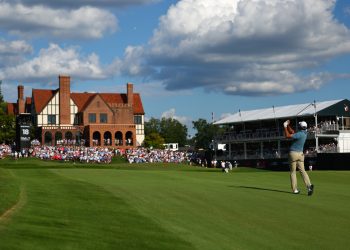
There are few Sundays — even during the NFL season — as dramatic as this past Sunday at Augusta, where Rory McIlroy finally triumphed at the Masters in a fashion alternatively excruciating and exhilarating. In the aftermath of the most stirring final round of the Masters since Tiger Woods’ all-time win in 2019, perhaps the only bigger winner than McIlroy on Sunday was CBS.
Airing the Masters for a 70th consecutive year, CBS generated no small amount of praise for its coverage of Sunday’s final round, much of which was earned for knowing when to stay out of the way and let the pictures tell the story. Perhaps golf is better suited to that sort of treatment than other sports, but between the subtle graphics, lack of commercial interruption and near-constant focus on the on-course product, it was the rare sports TV viewing experience that made one feel some semblance of actually being there (with the caveat of course that there is no real substitute for actually being there).
For a network that started the week with a Sports Emmy nomination for last year’s Masters, it was a performance that seemed to lock in a victory at next year’s ceremony.
For as much credit as CBS deserves, it is also the case that Augusta National exerts unusually high levels of control over its image. CBS has aired the event for seven decades, but the rights are awarded on an annual basis and for no rights fee. Augusta National could conceivably pull them at any time for any reason, and there would be any number of networks eager to enter the mix. (Fellow PGA Tour broadcast partner NBC, which airs the Augusta National Women’s Amateur and assigns its top voice Mike Tirico to cover the event, would be an obvious contender.)
Augusta National thus has considerable leverage over its television partners, who are keenly aware of how the club seeks to be portrayed. It is impossible to imagine the Stephen A. Smith of golf — Brandel Chamblee — lobbing his occasional bombs during a Masters telecast (instead, he was reduced to doing so on Skip Bayless’ podcast). The very idea of anyone trashing the event on-air, as has been seen in other sports, is out of the question.
There is little doubt that the reverence CBS (and ESPN) announcers show for the Masters is genuine, but it is also mandatory. After a few irreverent comments during the 1994 Masters, CBS analyst Gary McCord never covered the event again. A generation earlier, the widely respected Jack Whittaker was blocked for years from covering the event after he referred to the gallery on the 18th hole as a “mob.”
There are stories about the intricate language restrictions broadcasters face — “patrons” over “fans” and “bunkers” over “sand traps” are just two examples — a level of control that one simply does not hear about in other sports, or even in other golf tournaments.
Given the dissatisfaction in recent weeks about how national broadcasters cover the NBA and Major League Baseball, and the ways leagues like the NFL have exerted their leverage over partners in the past, The Masters stands out as an example that is impossible to duplicate. CBS and ESPN are on endlessly expiring contracts and have zero ability to outbid the competition, meaning that the only possible advantage they could have over a potential challenger is to provide the best possible coverage. For the Masters, that means reverence, competence and an exclusive focus on the event. (One is not going to see the stars of the CBS series “Tracker” conveniently located in the gallery, as one might see the stars of a soon-to-be-canceled FOX show at the World Series.)
The principle ‘keep it simple, stupid’ is rarely applied in sports television, but by necessity it is the guiding ethos of CBS at Augusta National. What does it mean that some of the best sports television is produced in part because the event holds considerable sway over the broadcaster? From a journalism standpoint it is far from ideal, particularly in years when Augusta National membership policies were — to put it lightly — controversial.
In general, however, sports telecasts are more entertainment than journalism, with the networks serving as a gatekeeper between the viewers and the competition they have tuned in to watch. In too many cases, the networks are obtrusive, self-interested and sometimes even dismissive of the product in ways that impact the quality of the broadcast. For better or worse, Augusta National ensures that is never the case for the Masters.
Given the deep feeling many at CBS seem to have for the Masters, it is entirely possible that the network’s coverage would be the same even if it had the cushion of a ten-year deal, or if Augusta National had a more hands-off approach. CBS Sports was after all led for decades by Sean McManus — son of one of the industry’s most eloquent broadcasters Jim McKay — and of all the networks may be the least prone to bombast and self-promotion. Yet even ESPN, perhaps the most prone to those qualities, approaches the event with the same reverence.
It truly could not be any other way.
Few networks have as strong a week as CBS does every-other-year when it carries the NCAA men’s basketball title game and the Masters in the span of mere days. Ian Eagle last week was the subject of no shortage of praise for his performance on the Final Four and national championship, with it becoming clear that he was a considerable upgrade over his predecessor Jim Nantz. Yet do not sell Nantz short. On golf, there are few who could have handled the moment better than he did on Sunday.
This is not breaking news, but the Tiger era is over. It was one thing to envision Woods winning another major in his early 40s, when his only meaningful injury was a recurring back problem, but now pushing 50 on a leg that could easily have been amputated following his 2021 car crash — and a torn Achilles on his other leg — the chances of him ever seeing major #16 have evaporated.
McIlroy and Jordan Spieth were, about a decade ago, viewed as his heirs. With Spieth so far replicating the career journey of Martina Hingis, McIlroy’s win on Sunday was no small moment for the game. It was his first major victory in 11 years and by far his most significant. He is younger than people think, and if he truly takes off, he could rekindle the drawing power he had earlier in his career.
Plus: Sunday Night Baseball, Saturday night TV, NBA Playoffs
ESPN was live with Cubs 2B Nico Hoerner when he nearly collided with a teammate in the outfield Sunday night, and one wonders whether the benefit of the on-field interviews outweighs the risk. It is hard to imagine that the players are too distracted by the in-game interviews, and the ESPN announcers went quiet during the play in question. (Karl Ravech said he did not advise Hoerner about the possible collision because he did not want to interfere with the outcome.) Nevertheless, had the players collided, there is little doubt that there would be some outcry.
As he left the field, Hoerner said that it was “the last play you want while you have a microphone in your ear.”
On the plus side, ESPN was able to ask him about it immediately.
This weekend marked a rare Saturday night on which none of the “Big Four” broadcast networks aired live sports. ABC had the 1956 epic “The Ten Commandments” and the other networks were in reruns. It might have been a good night to showcase the NCAA men’s hockey final, which instead aired on ESPN2. (Then again, if ABC was going to air primetime hockey, it probably would have just carried an NHL tripleheader as it did on this same weekend last year.)
Given how much the bar has been lowered for sports on primetime television (FOX carried rugby in primetime last month), it is hard to imagine there will be many more nights like this past Saturday on the “Big Four.”
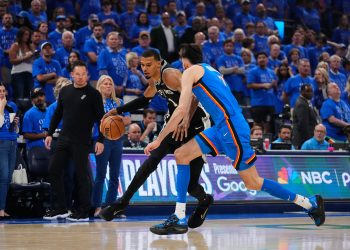
The NBA was a few possessions away Sunday from clinching a Warriors-Lakers opening round playoff series (and Nuggets-Timberwolves, which if lower on the marquee would still have been attractive). Instead, Golden State will toil in the play-in and the Lakers will face Minnesota. Having the Warriors and Lakers in separate playoff series is far from the worst outcome — assuming Golden State gets out of the play-in — and the bracket sets up for a potential second round matchup.
Of course, a first round meeting would have guaranteed that one of the two teams made the second round. Instead, it is entirely possible the league could end up with neither.
As noted by this writer on social media Sunday, the final seconds of Clippers-Warriors Sunday night marked a milestone for the NBA. After a 23-year gap, the league’s next regular season game will air on NBC.