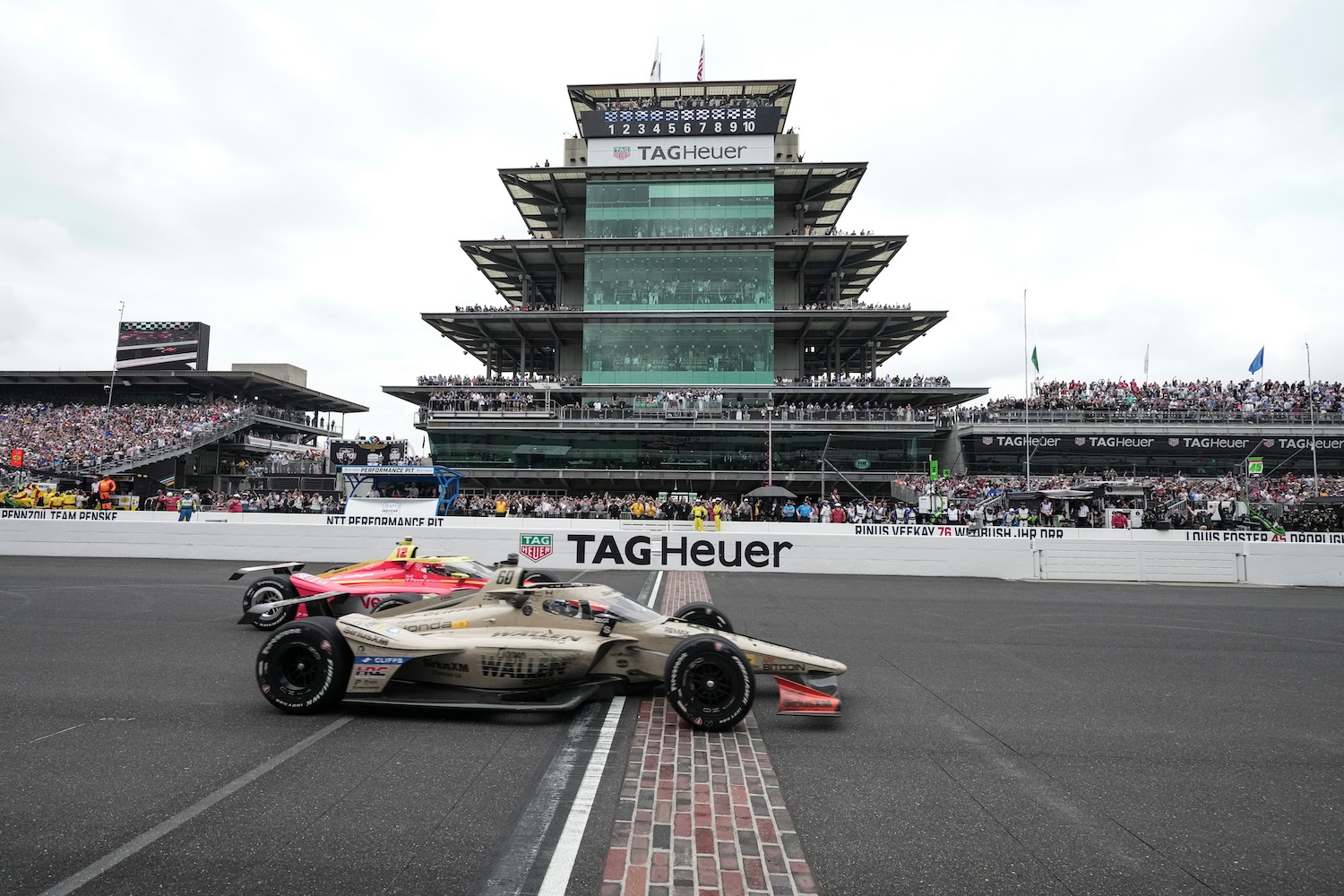
Despite an all-time finish, the Indianapolis 500 could not quite match last year’s milestone audience.
Last weekend’s Indy 500 averaged 6.635 million viewers on FOX, down 6% from last year’s 7.09 million, but still the second-largest audience for the race since 2012 (6.85M).
Felix Rosenqvist’s historically close win peaked with 8.35 million in the 4 PM ET quarter-hour, down a narrower 1% from last year’s peak quarter-hour (8.44M, per initial fast-nationals).
Note that this year’s Indy 500 was only sixth since Nielsen began tracking out-of-home viewing in its estimates and the second since it began doing so in 100% of markets. Those changes will result in favorable comparisons to past years, particularly before the out-of-home era began in 2020. (It is a virtual lock that the 2015 race — which averaged 6.48 million without any out-of-home viewing — would have had a larger audience all things being equal.)
The race was also the first since Nielsen rolled out a new methodology that combines “Big Data” from smart TVs and set-top boxes with its traditional panel. That change has also benefited sports viewing, though not across the board. NASCAR, the highest-profile of all racing series, has generally seen little if any lift from the new methodology and recently reverted to reporting its viewership using the old ‘panel-only’ methodology.
The Indy 500 averaged more than twice as many viewers as the NASCAR Coca-Cola 600 on Prime Video, which averaged 3.06 million viewers on a “Big Data + Panel” basis. The 117% margin is actually more modest than last year, when the Indy 500 won by 161% (7.09 to 2.72M).
While the Indy 500 has outdrawn the Coca-Cola 600 every year since 2014 that they have occurred on the same day, the margins have been considerably larger of late — particularly since the rights reshuffle two years ago that saw the 500 move to FOX and the 600 move to Prime Video. Indy won the head-to-head by 25% in 2022, 45% in 2023 and 71% in 2024 before hitting triple-digits the past two years.
Note that the Coca-Cola 600 outdrew the Indy 500 every year from 2001 — when it moved from TBS to FOX — until 2014.
Unlike last year, when the Indy 500 outdrew the same-year Daytona 500 for just the second time since 1993, this year’s edition was no match for the February race — which averaged 7.49 million.