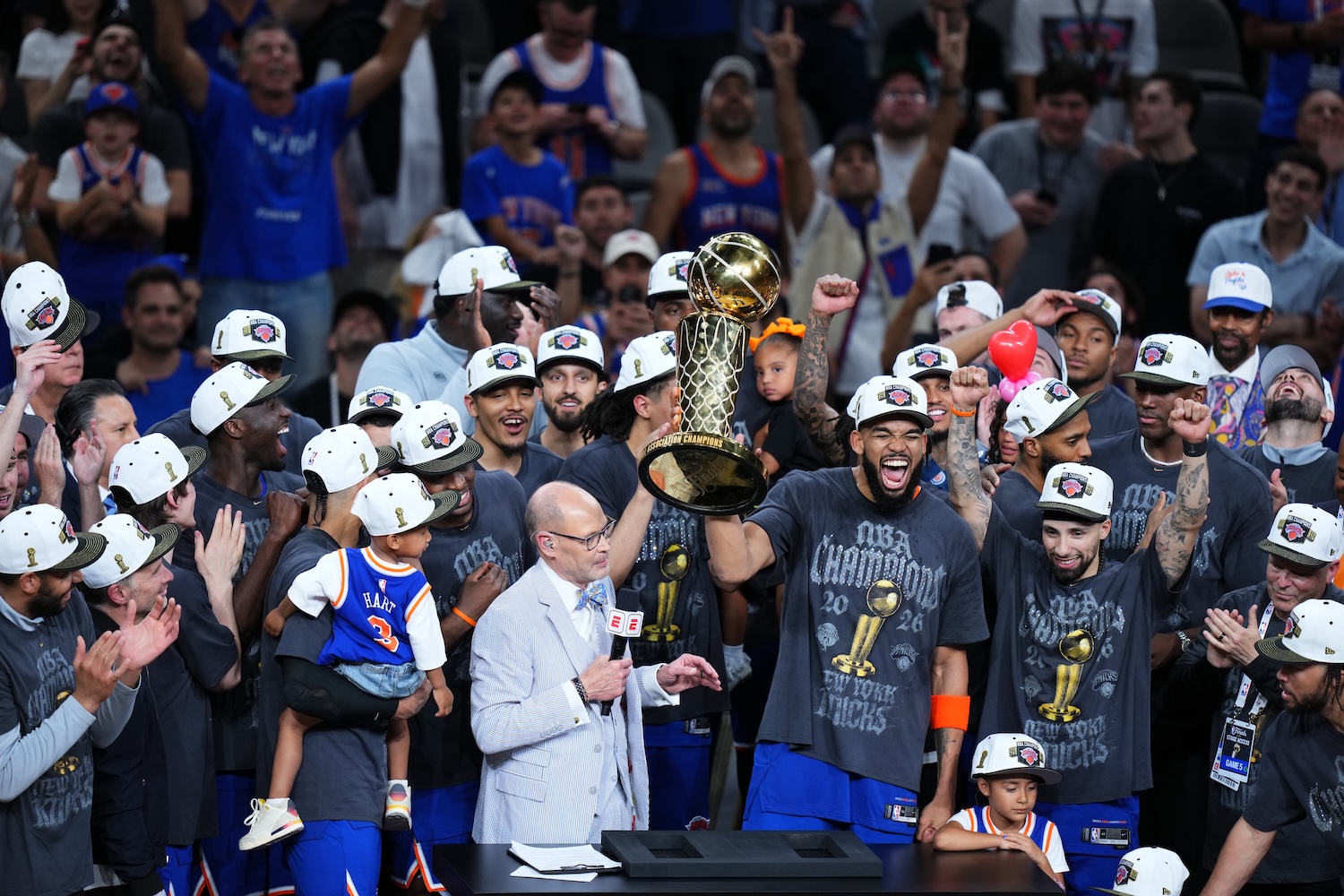
The New York Knicks ended a 53-year championship drought in front of the largest NBA audience in a decade, capping what is officially the most-watched NBA Finals since the days of Michael Jordan.
Saturday’s Knicks-Spurs NBA Finals Game 5 averaged a 10.3 rating and 24.54 million viewers on ABC, officially surpassing Cavaliers-Warriors Game 5 in 2017 (24.53M) to rank as the most-watched NBA game of any kind in a decade — since Game 7 of the Cavaliers-Warriors NBA Finals in 2016 (31.02M).
The Knicks’ title-clinching win, which peaked with 33 million viewers, also ranks as the most-watched Game 5 of an NBA Finals since Jazz-Bulls in 1998 (30.59M).
Note that Nielsen did not begin including out-of-home viewing in its estimates until 2020, only began doing so in 100 percent of markets a year ago, and is months into a new methodology that integrates its traditional panel with “Big Data” from smart TVs and set-top boxes. Those changes will skew historical comparisons, particularly to years before 2020. (It is a lock that Game 5 of the 2017 series would rank higher all things being equal.)
The full five-game Knicks-Spurs series averaged a 9.6 rating and 20.6 million viewers, officially surpassing Warriors-Cavaliers in 2017 (20.41M) as the most-watched NBA Finals since Bulls-Jazz in ’98 (29.04M). It ranks as the most-watched NBA Finals since ABC resumed airing the event in 2003, and the ninth-most watched in the Nielsen people meter era (1988-present) — trailing the Bulls’ six titles on NBC in the 1990s and the two Lakers-Pistons series on CBS in the late 1980s.
Most-watched NBA Finals, Nielsen people-meter era
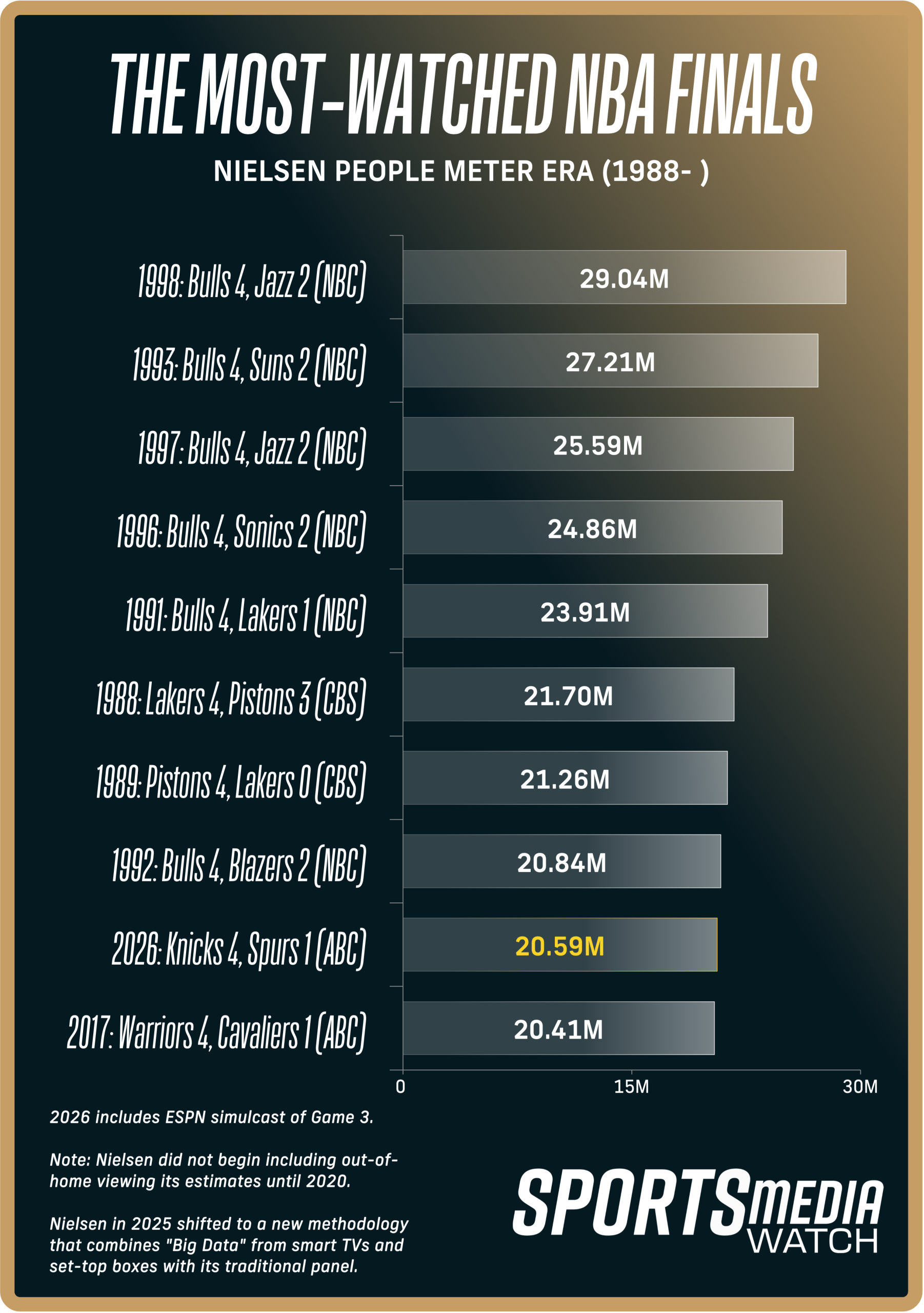
As previously noted, Nielsen methodological changes skew historical comparisons. It is almost certain that Warriors-Cavaliers in 2017 (20.41M), the Cavaliers’ seven-game win over the Warriors in 2016 (20.22M) and the Rockets’ four-game sweep of Orlando in 1995 (20.08M) would rank higher all things being equal.
The 9.6 household rating is the highest for an NBA Finals since the final Warriors-Cavaliers series in 2018 (10.0).
The NBA Finals ranks as the most-watched of the major North American championship series since the 2016 World Series, won by the Cubs to end a 108-year championship drought (23.4M). Viewership comfortably outpaced last year’s seven-game Dodgers-Blue Jays World Series (16.1M) and more impressively outdrew the five-game Dodgers-Yankees Fall Classic in 2024 (15.8M). That 2024 World Series pit the nation’s top two markets in a matchup widely believed to a best-case scenario. (The 2024 World Series would not have approached 20 million even under the “Big Data + Panel” methodology that became official Nielsen currency last year.)
Knicks-Spurs was a massive return to form for the NBA Finals after a slump that arguably began when LeBron James left the Cavaliers in 2018, bringing an end to his run of eight-straight years in the Finals — and his four-straight years playing against Stephen Curry’s Warriors. The next year’s Warriors-Raptors Finals got off to a surprisingly slow start, if quickly forgotten after two strong audiences in Games 5 and 6.
It was not until the COVID hiatus in 2020 that NBA Finals ratings really fell off, hitting an all-time low in the fanless, football-season “bubble.” The depressed COVID-era viewership was in keeping with the broader industry trend, but while other leagues eventually saw their championship events rebound, the NBA Finals remained middling in an era of parity — and fairly random matchups.
From 2020 through last year’s Thunder-Pacers Game 6, 34-straight NBA Finals games failed to hit the 14 million mark. Now, six-straight games have surpassed the 16 million mark, starting with last year’s Game 7 and running through this year’s five-game series.
While Knicks-Spurs was obviously a more attractive matchup than the league had seen in recent years, few could have imagined that the audience would surge to more than 20 million viewers — even with the various Nielsen methodological changes that have boosted sports viewing. That is especially the case given that this year’s series had an altered schedule to avoid the FIFA World Cup, with none of the games scheduled for Sunday night, the most-watched night of the week.
Instead, the series included a game on a Saturday night — the least-watched night of the week — for only the second time since 1981. That Saturday game ended up being the Knicks’ clincher, and now ranks among the five most-watched NBA games since 1998.
Compared to last year’s seven-game Thunder-Pacers series, this year’s Finals increased 88% in ratings and 100% in viewership from a 5.1 and 10.27 million. The Game 5 audience increased 157% from last year’s 9.54 million.
With all the caveats regarding changes in Nielsen methodology and viewing habits, viewership for this year’s five-game Knicks-Spurs series officially increased 29% from their previous matchup 27 years ago, which also went five games (16.01M). The Game 5 clincher increased 59% from 15.52 million.
During the lean years of late, the NBA Finals was still averaging the same share of the audience that had been commonplace in better times. With this year’s audience so much larger than in recent years, but the television universe still shrinking, the share for Knicks-Spurs was a whopping 38.3 — an increase of 78% from last year and the highest on record, surpassing the previous mark of 33.1 in 1993.