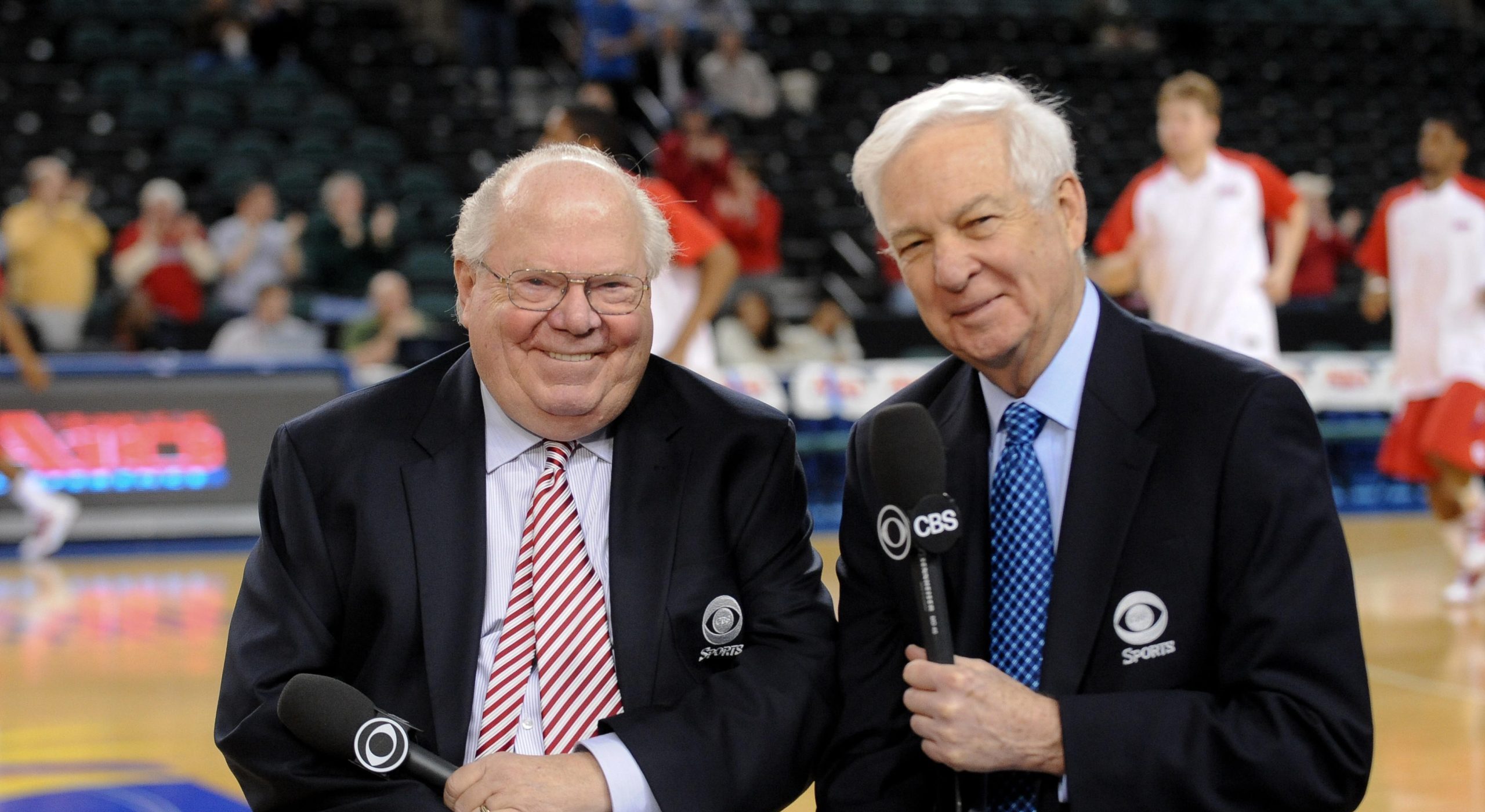
Verne Lundquist turned 86 on Friday, and to commemorate the occasion, Armand Broady offers this tribute in the latest edition of “On the Air.”
Every broadcaster lives for the big call — the walk-off home run, the buzzer beater, the Hail Mary touchdown. In those career-defining moments, play-by-play announcers know their words will be forever linked to sports history. Over a remarkable 60-year career, Verne Lundquist consistently mastered those moments, crafting calls that became as memorable as the moments they described.
His broadcasting journey began in the 1960s in Dallas, where he worked in local radio and television, sharpening a style that already felt distinct. Even early in his career, Lundquist possessed a rare combination of warmth and authority, plus a rich, smoky baritone that could boom through a radio speaker.
Dallas fans grew fond of that warm voice. Lundquist was named lead radio play-by-play announcer for the Dallas Cowboys in 1972 — just in time to chronicle the team’s golden era. The Cowboys reached the Super Bowl five times in the decade, earning the nickname “America’s Team” and giving Lundquist numerous opportunities to showcase his immense broadcasting talent.
Late in the third quarter of Super Bowl XIII, Cowboys TE Jackie Smith dropped a wide-open, game-tying TD pass in the end zone. Lundquist’s unique and earnest description has gone down in Super Bowl lore.
“Roger … back to throw … has a man open in the end zone … CAUGHT … TOUCHDOWN … DROPPED! Jackie Smith, all by himself! Oh, bless his heart, he’s got to be the sickest man in America!”
In those few words, Lundquist revealed the qualities that would largely define his career. The finest broadcasters process the game from their minds to their mouths, but Lundquist always left room for his heart. Rather than reacting as a dejected fan or an emotionless journalist, he instinctively viewed the moment through Jackie Smith’s eyes, giving voice to the agonizing heartbreak one man was experiencing.
Those skills opened doors at the network level. After a brief stint at ABC Sports, Lundquist joined the CBS Sports announcing roster in the early 1980s. That move transformed his career.
At CBS, Lundquist became one of the network’s defining voices, serving as play-by-play announcer for a host of properties.
Al Michaels’ “Do you believe in miracles?!” Howard Cosell’s “Down goes Frazier!” Joe Buck’s “Diggs! … Sideline! … Touchdown!” These famed TV play-by-play calls are recognized among a list of the greatest of all-time. Most network broadcasters have reached something of a pinnacle if they’re a part of one of those magical events. Lundquist has had several. And each time, he’s called them with succinctness, passion and his trademark human touch.
Jack Nicklaus was in pursuit of his record sixth green jacket at the 1986 Masters. He started the final day four strokes behind leader Greg Norman. A win would have made him the oldest, at 46, to ever win at Augusta.
Nicklaus’ spellbinding rally reached a crescendo on the 17th hole. As he rolled in his famous birdie putt, Lundquist unleashed his now legendary line, “Maybe … YES SIR!”
In 1992, another iconic play fell into Lundquist’s lap. During what is still considered by many the greatest college basketball game ever, Duke’s Christian Laettner took a full-court inbound pass from Grant Hill and hit a turnaround jumper to defeat Kentucky in the Elite Eight.
“Here’s the pass to Laettner … puts it up … YES!”
Though he spent much of his career one rung below legends like Pat Summerall, Al Michaels, and Dick Enberg, Lundquist serendipitously found himself chronicling some of the most unforgettable—and sometimes surreal—moments in sports television history.
He was on the call for the Fog Bowl of 1988 and the Nancy Kerrigan-Tonya Harding saga of the 1994 Winter Olympics. When mid-major George Mason University defeated powerhouse Connecticut in the 2006 Elite Eight, Lundquist was there (“By George, the dream is alive!”). When Michael Jordan played the first Game 7 of his career in the 1990 Eastern Conference Finals, it was Verne alongside Len Elmore.
No matter the sport, Lundquist could intuitively recognize the emotional weight of a moment.
The most famous example may have come at the Masters Tournament in 2005, when Tiger Woods produced one of golf’s most breathtaking shots on the 16th hole. As Woods’ chip rolled slowly toward the cup, Lundquist waited. Then came the line now etched into sports history:
“Oh, WOW! In your life have you seen anything like that?”
Another classic Verne call. The clever word usage. The pure and authentic emotion. No manufactured drama — just astonishment shared with millions. Like few other broadcasters before or since, Lundquist could bring the viewer along for the ride, then lose himself in the frenzy.
Frenzy is a fitting word for the atmosphere produced by college football. For 16 years, Lundquist served as the voice of the SEC on CBS. During his fondly remembered tenure, the 3:30 p.m. time slot became appointment viewing, and the SEC became college football’s primary source for television theater.
The 2013 Iron Bowl is so iconic that it is best known by two words, “Kick Six.” The fourth-ranked Auburn Tigers were hosting their bitter rivals, the top-ranked and two-time defending champions, the Alabama Crimson Tide. The game produced one of college football’s greatest and most extraordinary endings. As he had done so many times, Lundquist delivered a call that captured the disbelief and chaos with remarkable clarity, preserving a moment that still gives fans chills.
“Davis goes left … Davis gets a block … Davis gets another block … Chris Davis! … Touchdown AUBURN! An answered prayer!”
As Auburn CB Chris Davis returned a missed FG 100 yards on the game’s final play, Lundquist had once again provided the perfect caption. That was his gift: the right words at the right time with the right emotion.
All good announcers manically prepare for their broadcasts, but what often separates great calls from historic calls is not the preparation done ahead of time, but the reaction made in real time. In this area, Lundquist stands above most.
Greatness in play-by-play broadcasting is not about being the smartest voice in the room. As Verne Lundquist’s career proved, it is about knowing exactly when to speak—and saying just enough to make the moment live forever.