Tom Jackson, the longtime ESPN NFL analyst who along with Chris Berman formed one of the most durable and memorable partnerships in sports television history, has died. He was 75.
Berman, appropriately, announced the news on ESPN’s “Sunday NFL Countdown” Sunday morning, describing Jackson’s passing as a shock. Jackson, Berman said, had been a “vital 75,” and the two of them had been in regular contact, including just this past week. Jackson also made a “surprise visit” to the ESPN NFL set three weeks ago. A cause of death was not known.
Jackson worked for ESPN from 1987-2016 and had a brief return on the rebooted “NFL Primetime” in 2019, working alongside Berman in all of those years. His partnership with Berman is the longest host-analyst pairing in the history of U.S. sports studio shows, lasting one year longer than the pairing of TNT Sports’ Ernie Johnson and Kenny Smith (1998-present).
Jackson was mulling an offer to join NBC when ESPN sought him out for an audition in 1987, he told Jim Miller and Tom Shales in “Those Guys Have All the Fun,” the 2011 book about the history of ESPN. He and Berman met for the first time and something “just clicked,” he said.
In or out of the studio, and regardless of the role, the Berman-Jackson pairing ranks among the very longest in U.S. sports television history. Fox NFL analysts Terry Bradshaw and Howie Long have worked together for 32-straight years; Kirk Herbstreit and Lee Corso had been together on “College Gameday” for 29 when Corso retired last year. So foundational to ESPN history is their partnership that the company’s NFL studio is named after them.
What made it work, beyond their evident friendship, was the way their roles complemented each other. Berman provided the bombast — the catchphrases, the energy, all of which he can still summon to this day in semi-retirement — while Jackson offered the substance, the steak to the proverbial sizzle. If Berman was the flashy gunslinger quarterback, Jackson was the dependable receiver who could catch even the wildest pass.
“My ability to quickly analyze and to know when to get in and out was key,” he told Miller and Shales, “because you never want to get away from what [Berman] is doing. So I began to understand my role — get in and out — and allow that highlight package to flow.”
Not entirely unlike NBC’s Dan Hicks, whose passing earlier this month shocked the industry, Jackson was the type of broadcaster who did not bring attention to himself, and as a result could be taken for granted. Yet one look at his various roles makes clear just how important Jackson was at ESPN. Most studio shows have a single host and multiple analysts. On “NFL Primetime,” it was Berman who occasionally shared the stage — with co-hosts like Robin Roberts and Stuart Scott — while Jackson remained the sole analyst.
Even as part of an ensemble studio team on the Sunday and Monday editions of “Countdown,” Jackson was in every sense of the word the lead analyst — not just the one whose football acumen was the most respected, but the leader of the team, even its conscience when events warranted.
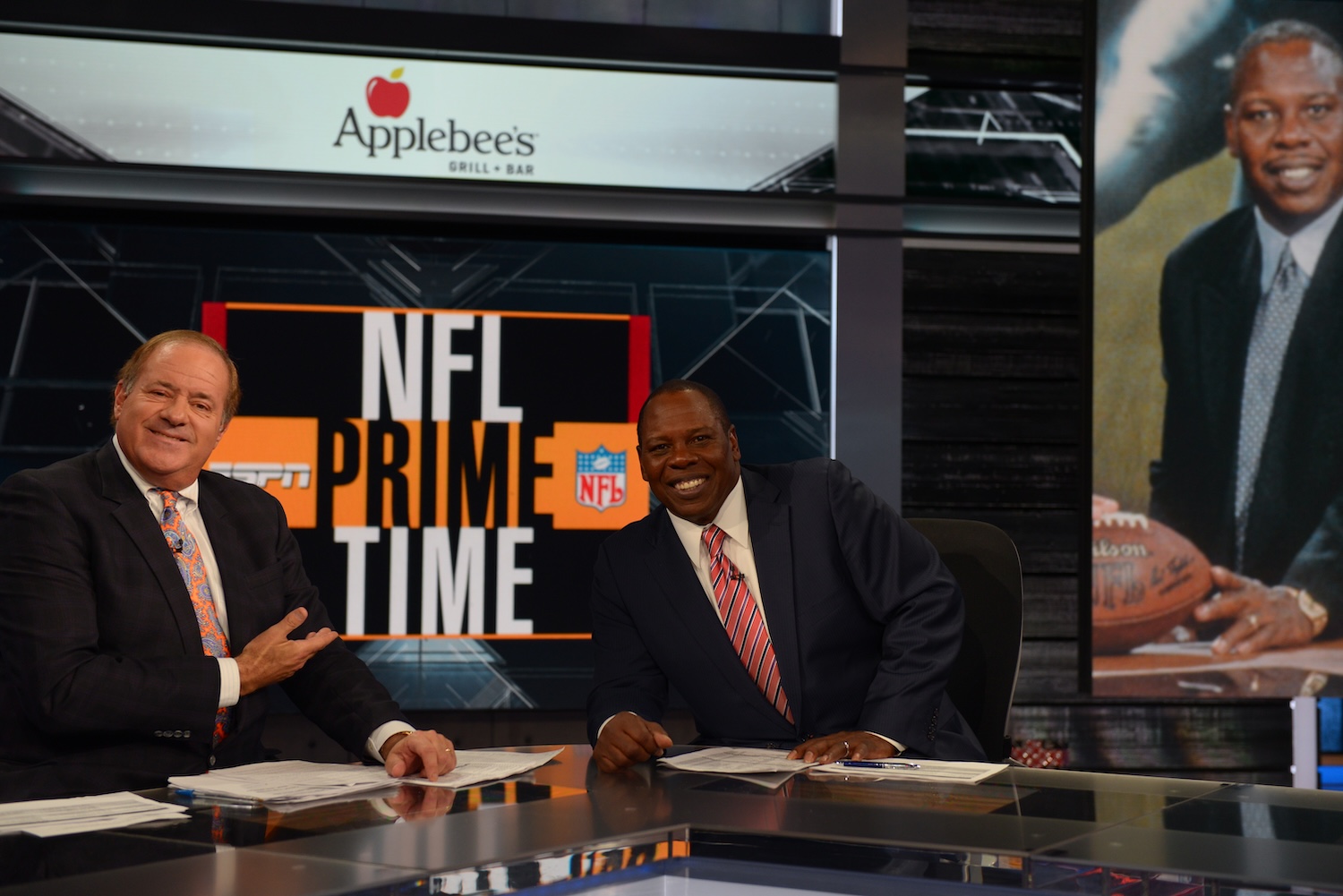
(Photo by Melissa Rawlins / ESPN Images)
After the Rush Limbaugh debacle in 2003 — in which ESPN hired the political provocateur as the ‘voice of the fan’ on “Countdown,” then weathered controversy when he, perhaps inevitably, suggested that then-Eagles QB Donovan McNabb had received unwarranted praise because of his race — it was Jackson more than anyone who bore the brunt of responsibility. Not because he hired Limbaugh, not because he agreed with him, but because more was expected of him than of the executives in charge.
In the days following Limbaugh’s comment, Jackson incurred days of criticism for not pushing back in the moment. (“The biggest surprise,” one columnist wrote amidst dozens of op-eds on either side of the national controversy, “was that fellow panelist Tom Jackson, who is black and was one of the game’s top linebackers in his day, didn’t blitz Rush and knock him on his fat ego.”)
He was not alone in receiving criticism, but Michael Irvin was not expected to be a leader or set an example. Jackson accepted that responsibility. According to Limbaugh, quoted in the Miller and Shales book, ESPN executive Mark Shapiro relayed to him that Jackson had issued an ultimatum. “He’s saying it’s either you or him,” Limbaugh recounted. “Tom Jackson at that time had been there sixteen or seventeen years. This was my fifth week.”
Jackson was “the focus” of the show the following week, as noted at the time by Chicago sports media critic Ed Sherman. On arguably the most scrutinized episode of an ESPN NFL studio show in the history of the company, it was Jackson’s voice that resonated the loudest, his words that carried the most weight. Not Berman, not Irvin, and certainly not Shapiro. He read a statement on-air that he said was “slightly diluted” from its original draft, but made clear that the hiring was not the decision of any of ESPN’s talent — a rare instance, at least for the time, of ESPN talent pushing back on-air against executives.
That was Jackson. When the bombast died down, whether the pomp of a Berman highlight or the invective of a political pundit, he was the one tasked with making it all make sense. He may not have been the host, but he was the anchor of that studio every time he stepped foot on set.