Sports Media Watch presents thoughts on recent events in the industry, starting with a look at what ESPN’s aggressive content buildup means for its new direct-to-subscriber service.
ESPN president Jimmy Pitaro has said that ESPN’s new direct-to-subscriber option is meant to attract those viewers who are “sitting on the sidelines,” outside of the cable bundle. But are the network’s various enticements enough to attract cost-conscious fans?
The Content Factory
When Dan Patrick left ESPN in 2007, he initially ended up at a company called “The Content Factory.” For what it’s worth, that is a good description of ESPN today. ESPN has in just this month been as aggressive as at any point in its recent history — more aggressive even than the new Paramount Skydance — making deals that go far beyond traditional national game inventory to beef up its newly launched direct-to-subscriber app.
ESPN has in recent weeks announced its planned acquisition of NFL Network and a deal to secure WWE premium live events, both of which are to be available on its “ESPN Unlimited” direct-to-subscriber plan. It is in discussions to acquire MLB.tv and local rights to five MLB clubs, which along with potentially MLB Network would also be available through the app. It is reportedly looking to soothe the sting of losing UFC rights by licensing the UFC Fight Pass service. It is offering discounted bundles that would pair the app with the new Fox DTC app or with NFL+ Premium.
ESPN has reached or pursued these deals even as it is paring back its live game inventory, as noted in this column last week.
While live games are still ESPN’s lifeblood, they have not really been the main focus of discussion for the new app, but rather the in-app features and aforementioned deals. For those receiving the app through the cable bundle, games are no differentiator; they already have access to them. For those who are not currently in the bundle, is there a single game coming up on ESPN that would make a cord-cutter sign up for a $30/mo service? It seems doubtful.
That may help explain the mixed messaging surrounding the launch of the “ESPN Unlimited” service. ESPN has through its marketing painted the launch as a foundational moment in its history, on par with that September day in 1979 when it debuted.
But ESPN has also managed expectations, and understandably so. It is not expecting people to leave the bundle to buy the standalone app — to begin with, many of them will not need to, as a number of cable and streaming subscriptions include an ESPN Unlimited subscription for no extra charge — but instead to attract those viewers who left the bundle but are still interested in live sports. That is a demographic consisting of people who are interested enough in live sports to potentially purchase ESPN for $30/mo, but not so interested as to be part of the bundle. One might be tempted to use the old Jerry Seinfeld line: “who are these people?”
The general sports fan is relatively easy to figure. He or she needs access to multiple channels and the ability to easily switch between them in order to satisfy various interests. Thus, the bundle. While there are concerns among distributors that free access to the ESPN Unlimited service could lure viewers away from the bundle, it is hard to imagine that a little multiview here and a little betting integration there will overcome decades of muscle memory and habit. People who are still with the bundle are with the bundle for a reason.
The kind of fan who currently sits outside of the bundle is one who does not view nationally televised games as particularly essential. One may generally assume that kind of a fan is the proverbial casual who might only tune in only for a championship event. But in some cases, that fan has a specific interest in one sport or one team that can be satisfied with a handful of DTC apps. Maybe a Guardians fan in Ohio, or perhaps California, who just needs the 162-game grind. Or an NFL junkie whose needs are met with one $15/mo NFL+ Premium subscription.
ESPN would seem to have designs on becoming a clearinghouse for those niche, team or sport-specific networks, apps and shows that have their own built-in followings — NFL Network and NFL RedZone, NHL Power Play and MLB.tv, maybe even MLB Network. Perhaps one day NBA TV. Why not Tennis Channel, which Sinclair is reportedly shopping, or even Golf Channel down the line? If it can become the exclusive or most cost-effective home of some of these services, even better.
ESPN is trying to shift to a model where you need ESPN. Want to see your favorite team? You will need ESPN. Want 24 hours of NFL coverage seven days a week? You will need ESPN. For the casual, general sports fan, ESPN may be a nice-to-have. But for the diehards? ESPN will be essential.
Many of those diehards are already accounted for in the bundle, but not all of them.
It is a strategy that would ultimately force some of those bundle holdouts off the sidelines and onto the app. Ultimately, if ESPN buys up everything, good luck watching sports without it. And the more ESPN buys up, bundles and licenses, the more essential it will become to even the cost-conscious, cord-cutting sports fan.
Plus: World Baseball Classic, Eisen return, YouTube vs. Fox
Major League Baseball announced a major media rights deal with Netflix on Monday, but not the one you may be thinking. The streamer has acquired rights to next year’s World Baseball Classic in Japan, where the popularity of the Shohei Ohtani-led national team fueled massive audiences during the previous WBC two years ago. The deal is yet another example of the Netflix sports strategy, which is to acquire exclusive rights to standalone events.
That strategy could pay serious dividends for events that have largely been taken for granted, like the WBC — not just in quality of coverage, but in elevating their value. When prior to now would one have thought of the WBC as a valuable standalone property?
It should be pointed out that MLB has not announced U.S. rights for next year’s WBC. It is safe to assume it would again air on Fox Sports, but if Netflix is interested at anything approaching a competitive price, it would be hard to imagine MLB turning them down.
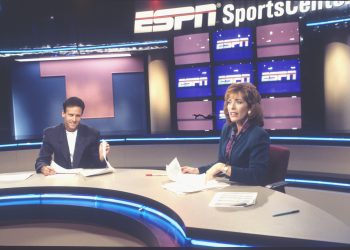
The return of Rich Eisen to “SportsCenter” last Monday night was, pardon the pun, rich in nostalgia. From Eisen’s scripted voiceover over the saxophone-heavy 1990s “SportsCenter” theme to a poignant remembrance of Stuart Scott, there were moments there for any viewer who remembered the “SportsCenter” of old.
It was also perfectly timed. A reminder of what ESPN was, what ESPN now is, and where ESPN is going. Yes, there were old-school highlights, even a “Did You Know?” — but by and large not until the back half of the show. The first half of the show was devoted to lengthy, in-depth analysis of the preceding NFL preseason game. Old “SportsCenter” zipped from game to game and story to story — Michael Jordan confirming his comeback to the NBA did not even occupy the entirety of the “A” block in March 1995 — but new “SportsCenter” is at times more of a postgame show than a highlight show.
More than anything it was a signal of what is ahead. Eisen was not returning to “SportsCenter” just for doing so, but as part of his broader deal to bring his eponymous radio show to ESPN Radio and ESPN’s various digital platforms. And there will be much more Eisen on ESPN, assuming the network’s deal to acquire NFL Network is approved.
If ESPN of the 1990s was defined by “SportsCenter,” today’s ESPN is pretty clearly defined by its app.
The apparent conflict between Google-owned YouTube TV and Fox Corporation will allow for a test of the new status quo. Now that the networks have their own direct-to-subscriber services, can they more easily weather a carriage dispute? Will there be less pressure to come to a deal? It may be a tough sell to get someone who is already paying more than $80/mo for YouTube TV to add on another $20 to get Fox One, but a $10 YouTube TV credit — commonly offered in these situations — would account for half of that price.