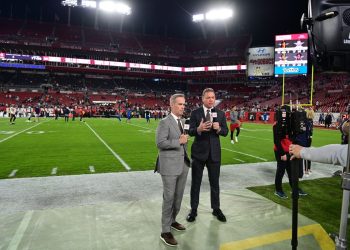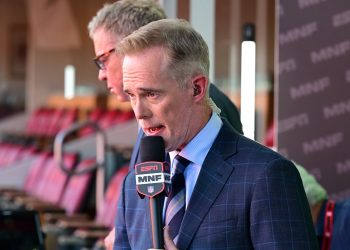
Last year, ESPN named Artie Kempner its new “Monday Night Football” director. By all accounts, it may be one of the smartest moves ESPN has made relative to its “MNF” presentation. A 12-time Emmy winner, Kempner worked with lead announcers Joe Buck and Troy Aikman at Fox for many years. His addition is a concession that, for as much work as ESPN had done to improve its production, “MNF” still needed some fine-tuning.
“I feel like we are not in the same conversation with Fox and CBS relative to our overall game presentation,” ESPN president of content Burke Magnus said to Andrew Marchand of The Athletic in the March 2025 column.
Magnus’ words were appropriate within the context of the Kempner hire, but truthfully, they’ve been accurate for much of the 20 years ESPN has owned the property. NBC was trotting out heavyweights Al Michaels and Cris Collinsworth with the legendary producer-director team of Fred Gaudelli and Drew Esocoff. CBS had caught fire with the effervescent Tony Romo and the graceful Jim Nantz. At Fox, Buck and Aikman had become joined at the hip — as synonymous with the NFC as Summerall and Madden had been at CBS and Fox.
ESPN, meanwhile, was saddled with second-tier games and a subpar production. When it finally began to turn a corner with the Mike Tirico-Jon Gruden broadcast tandem, the former headed off to NBC in an industry-changing move.
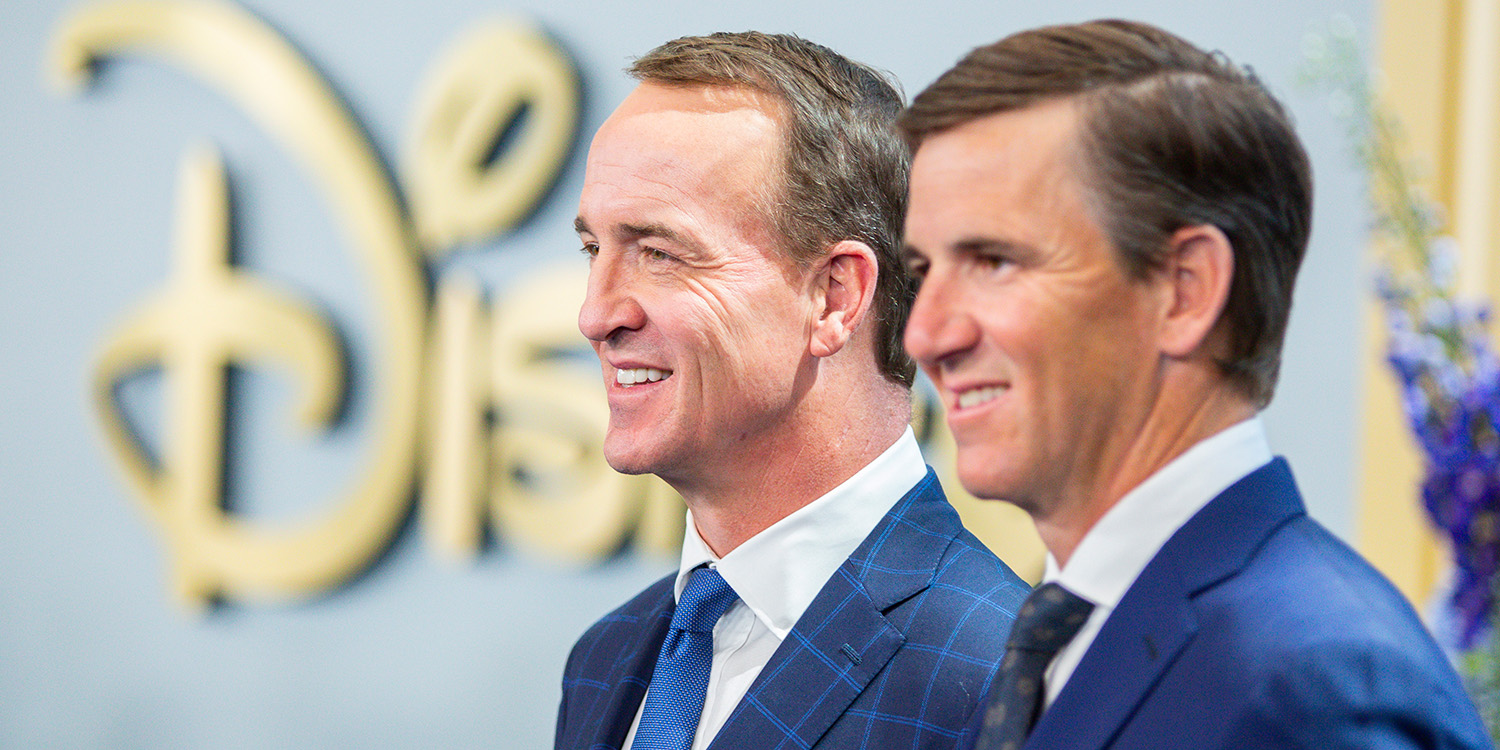
Years of stumbling led the company to try a new experiment. Peyton and Eli Manning, two of the most famous QBs of the last 30 years and men whose fame extends well past the white lines of the gridiron, carved out a different approach to game broadcasting. In September 2021, ESPN2’s “ManningCast” was born — part X’s and O’s, part late-night talk show. It was to be bold and innovative, a fresh alternative to the more buttoned-up presentation on the main ESPN channel, a chance to hang out with two of the most prominent names in football history.
The viewers responded. The ManningCast debuted with 800,000 viewers and quickly ascended into the million-plus range, peaking in early November 2021 when nearly two million viewers watched Peyton and Eli break down a Chiefs-Giants MNF matchup.
But in 2022, ESPN rocked the sports media world when it snagged Buck and Aikman from Fox. Taking nothing away from the capable trio of Steve Levy, Brian Griese and Louis Riddick, Buck-Aikman is an obvious upgrade in star power and broadcast quality. As fans have become more comfortable with the legendary duo on the main broadcast, the ManningCast has lost its luster.
According to Marchand, this past Monday’s ManningCast drew just 705,000 viewers. The show has been trending south for some time, now. At no point last season did any of the ManningCast episodes draw even one million viewers. Some claim that the show features too many celebrity interviews. That is a reasonable argument, but there is a broader point to be made.
This moment in time can be described as the era of the personality. That distinction would explain why Pat McAfee receives countless hours of airtime across a host of ESPN shows. Executives feel his charisma is so attractive that viewers will run to whatever channel he’s on. According to a recent report from Marchand, ESPN is planning to launch a new McAfee-fronted alternate presentation of “Monday Night Football,” pending the NFL’s approval, that would air during weeks when Peyton and Eli are off.
McAfee has already fronted several altcasts for ESPN, most recently during the NBA Finals. For years, he’s hosted the “Pat McAfee Show Draft Spectacular” during the NFL Draft. While it predates his ESPN tenure, the alternate NFL Draft show has become such an integrated part of ESPN’s coverage that the company included it in the viewership figure reported for the event this year. For the last four years, McAfee’s altcast “Field Pass with The Pat McAfee Show” has been a feature of ESPN’s College Football Playoff coverage.
These alternate broadcasts can on occasion offer entertainment, but in 2026, what purpose do they really serve? Sure, the names McAfee and Manning carry a certain cachet, but sports fans have a glut of options on YouTube and other platforms if they want to hang out with their favorite content creators.
The most memorable moments in sports belong to the competitors. Commentators can enhance the drama, but it is the participants who give those moments their meaning, weight and lasting value.
It is a hard question, but it must be asked: If the ManningCast were canceled, would viewers stop watching “Monday Night Football”? If Pat McAfee decided to give up his Field Pass shows, whom would it really affect? The games would still be played, ESPN would still broadcast them, and professional announcers would still give the games a polished sound.
The pandemic forced the media world out of its comfort zone, creating opportunities for savvy media members to flex their muscles and experiment. But as the sports world has returned to normal, the novelty of cleverly-produced alternate broadcasts has worn off. What was true of sports media in years past remains true today — innovation may capture attention, but substance is what ultimately sustains it.
By hiring Joe Buck and Troy Aikman, ESPN — whether it realized it or not — made the ManningCast a needless secondary broadcast. What ESPN needed is what every network has needed, good games called by respected announcers. The alternate broadcasts had their moment in the sun, but in 2026, they’re just not worth the effort.
Plus: How announcers handle bad games
If you listened to the FOX “Big Noon Saturday” broadcast of Kent State vs. Ohio State, you noticed that Gus Johnson’s energy seemed a bit off. The polarizing play-by-play voice is known for his excitable delivery, but during Saturday’s broadcast, he was strikingly low-key.
It is unknown if Johnson was dealing with an illness or injury. As hard as it may be for some to hear, it is plausible that Johnson found it difficult to get excited about a game no one expected to be even remotely competitive. Ohio State scored the game’s first 59 points before Kent State nailed a field goal with less than two minutes remaining. Throughout the game, Johnson met the action with subdued calls, raising a broader question about how announcers should approach games that are neither competitive nor compelling.
After a season of underwhelming matchups, legendary play-by-play voice Al Michaels faced heat for sounding bored with his inaugural “Thursday Night Football” slate in 2022. He responded in an interview with The Athletic, “I mean, you just can’t oversell something. Do you want me to sell you a 20-year-old Mazda? That’s what you’re asking me to do. I can’t sell you a used car.”
The image of the NFL’s longest-tenured TV play-by-play voice comparing games to used cars is amusing, but Michaels’ assertion is worth exploring.
Part of the job of announcers is to give viewers a reason to care, but sometimes that task is almost impossible. When a game is poorly played or when one team is clearly superior to the other — as was the case on Saturday — the competition itself ceases to be the story.
Viewers often expect announcers to bring enthusiasm to a broadcast regardless of the quality of the game, and to some extent, that expectation is reasonable. But when the talent gap between two teams is that pronounced, announcers naturally take their foot off the gas. The challenge is finding the right balance — acknowledging that the game is no longer competitive without draining the broadcast of the energy that makes it entertaining.