NBA All-Star ratings and viewership went in opposite directions.
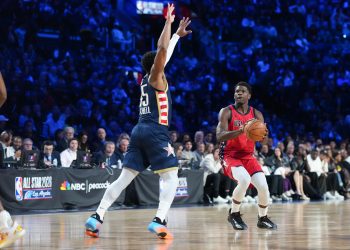
 Sunday’s NBA All-Star Game earned a 4.3 rating and 7.65 million viewers on TNT and TBS, per Nielsen fast-nationals — up a tick in ratings but down 1% in viewership from last year (4.2, 7.75M). Compared to 2016, ratings were flat and viewership inched up a fraction of a percent from 7.61 million.
Compared to the last Winter Olympic year in 2014, ratings were flat and viewership increased 2% from 7.51 million.
The unusually competitive contest, which peaked with 8.2 million viewers from 9:15-9:30 PM ET, delivered the second-largest NBA All-Star audience since 2013 (8.1M). It was the most-watched All-Star Game in a Winter Olympic year since 2002, when the game aired on NBC between Olympic telecasts (13.1M).
Keep in mind NBC’s competing Olympic window (10.2, 18.2M) was significantly weaker than in 2014 (12.1, 21.4M) or 2010 (13.2, 23.3M). Even so, that is the toughest competition the All-Star Game has faced since the Saturday Night Live anniversary special in 2015.
NBA All-Star ratings have been remarkably stable of late. The game has had either a 4.2 or 4.3 rating in five straight years, with viewership ranging from 7.18 and 7.75 million over that span.
In the key young adult demographics, Sunday’s game had a 3.3 rating in adults 18-49 (+6%), a 3.5 in adults 18-34 (+9%), and a 3.1 in adults 25-54 (+3%). The adults 50+ demo slipped from a 2.2 to a 2.1.
Compared to other All-Star games, Sunday’s game trailed last month’s Pro Bowl on ESPN and ABC (5.3, 8.6M) and last year’s MLB All-Star Game on FOX (5.5, 9.3M). It easily topped the NFL (2.4) and MLB (2.3) games in adults 18-49.
Given the Olympic competition, it is hard to gauge how much of an impact the new All-Star format — and renewed effort by the players — had on the numbers. It seems a safe bet that if not for the Olympics, this year’s game would have hit at least a five-year high (even just a 4.4 and 7.76 million would have done the trick).
The full historical list of NBA All-Star ratings, including 1990s numbers, is available here.
[Sun. numbers from Turner Sports, Sports Business Daily 2.19, ShowBuzz Daily 2.21]