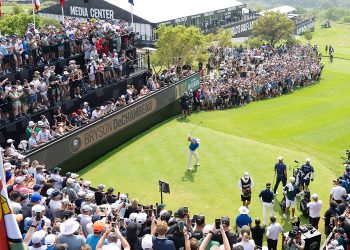
Sports Media Watch contributor Drew Lerner was granted inside access at LIV Greenbrier to interview LIV’s Chief Media Officer Will Staeger and tour the league’s broadcast facilities. This is part two of a two part series that will focus on LIV’s status as a sports property amid professional golf’s new world order, and examine the broadcast innovations LIV is making that they believe will change golf telecasts for the better. Part two will give a peek inside the LIV production trucks and focus on how LIV’s television broadcasts differ from traditional golf broadcasts for better and for worse. Read part one here.
WHITE SULPHUR SPRINGS, W.V. — As I wrap up my interview with LIV Golf’s Chief Media Officer Will Staeger during the final round of LIV Greenbrier, he gives an unprompted parting shot for his fellow broadcasters.
“We’re flattered that our brethren at NBC, CBS, and ESPN like to use our concepts in what they call innovation.”
Inside the LIV operation, there is plenty of us-versus-them mentality. So when Staeger saw NBC using a graphic during this year’s U.S. Open that looked similar to one that LIV debuted earlier this season, he took notice. The graphic (shown below) breaks down a player’s scoring average on a given hole based on where they place their tee shot.

LIV is quite proud of the investment they have put into their broadcast. As Senior Vice President, Production James Watson put it, LIV “treat[s] every tournament like a major.” That includes six separate broadcast trucks, an Australian company contracted to produce graphics, an Austrian company contracted for 3D visuals, two hundred crew members, fifty cameras, and one hundred microphones.
As seems to be the modus operandi with the Saudi-funded tour, no expense has been spared.
The Good
When money is no object, it turns out you can buy some pretty neat broadcasting toys. One interesting aspect of LIV’s broadcasts are that everything is proprietary. Traditional PGA Tour partners like Trackman for shot-tracer technology or ShotLink for shot-by-shot data refused to work with LIV, so those technologies were all developed in house either by the LIV team or contracted companies.
After spending about an hour hopping between the six production trucks, one of the workflows I found striking was the autonomy given to the graphics producers. On a traditional broadcast, a graphics producer will cue an element for the director, the director will decide whether to bring it to air, and the lead producer will communicate the graphic to the announcers. LIV, however, allows the graphics producers to bring elements directly to air themselves. The theory is that the broadcast can provide the viewer more information and statistics at a quicker rate than a traditional broadcast.
Another impressive graphical element is the “LIV Line” (shown below) that displays how a putt will break before it is hit.

Reading a green is difficult enough while standing directly on top of it, and proves even more challenging on a television screen. The simple, real-time interpolation of the line onto the green gives viewers a visual guide to accompany how the putt is being described by the announcers.
LIV’s visuals also match the quality of your traditional modern-day golf broadcast with many different types of cameras, a drone, and ample television towers.
Considering LIV is in just its second season and had to build an entire broadcast from the ground up in just a few months, it’s impressive how far they’ve come, and reasonable to expect further refinement during the upcoming offseason.
The Bad
While I commend the work LIV has done with their graphics, the scorebug (as seen in the above pictures) is simply too obstructive. It has shrunk since LIV’s inaugural season in 2022, but still takes up a large portion of the screen. Part of golf’s appeal as a television product is the natural beauty of the setting it is played in. Such a large scorebug intrudes on golf’s aesthetic. By contrast, the PGA Tour’s scorebug is quite minimalist in the bottom-right corner of the screen, and still manages to fit a player’s full name rather than an abbreviation.
Staeger and Watson would often talk about how they want LIV’s broadcast to look more like a video game than a golf broadcast. The league would like to attract a younger audience, so this makes some sense. However, by doing so, LIV runs the risk of alienating golf’s core audience.
After not seeing Nielsen data since LIV’s opening tournament in Mayakoba, data obtained for the last two tournaments show LIV averaging a mere 191,000 viewers during its weekend broadcast windows on The CW. In a “product vs. product” world, viewers are choosing with their remotes, and so far their choice is clear.
LIV also cites significant audio innovation, but I’m not convinced they’re using it to its full potential. This isn’t for lack of trying. LIV now mics up caddies so viewers can listen in on conversations with the player — access the PGA Tour should push its membership for — and has plenty of microphones situated across the course. However, the blaring music that can be heard throughout the course makes any audio innovation futile.
The Concerning
A concerning part of LIV’s broadcast can’t be seen directly on the screen. Something I mentioned in my initial review of LIV’s broadcast is the constant self-promotion. It comes off as a defense mechanism for an inferiority complex. Internally, LIV has the culture of a scrappy startup. There is massive buy-in and genuine belief in the product.
This environment manifests itself in an interesting way within the production trucks. The particular day I spent at LIV Greenbrier also happened to be the day that Bryson DeChambeau shot a 58 en route to victory. While observing the trucks during the front 9, the affinity for DeChambeau from the production crew was palpable. Each successive birdie was met with raucous applause, hooting and hollering from the crew. This was well before a sub-60 round — rarified air in professional golf — became a realistic endeavor.
The reason for celebration wasn’t because the crew was filled with DeChambeau fans either. Rather, they knew that a win from a high-profile player like DeChambeau would turn necks in the golf world. Certainly more than the likes of Richard Bland or David Puig would. Golf broadcasting should not set the standard for unbiased journalism, but the incentive structure of a broadcast crew is certainly skewed when it is owned and operated by the league. When NBC or CBS airs the PGA Tour, there is at least a level of separation between the league and its broadcast partners, leaving some room for the former to be critical of the latter.
The Tension
At the end of the day, LIV has handcuffed itself from a broadcast perspective with the structural decisions the tour has made. The shotgun start which LIV has married itself to is simply not conducive for good storytelling. With golfers all finishing their rounds at the same time on different holes, the tempo of the tournament is ruined. The broadcast feels disjointed and frenetic as they cut from hole to hole trying to track both the individual and team competitions simultaneously.
Those within LIV would counter that the viewer does not need their hand held, that they can sort through the chaos. Maybe so. However, one thing is certain. By using a shotgun start, you are shortening the window with which tension can be built. A close finish on LIV may take place over the course of 20 or 30 minutes as golfers play their final few holes at the same time. A close finish on the PGA Tour could take place over the course of an hour or more given the staggered starting times. This builds tension.
That word kept coming to mind while I watched LIV. Tension.
From a pure broadcast perspective, there are a few sports I’d categorize as “deliberate.” Golf, tennis, baseball, and football. They are slow and disjointed by nature and thus rely more on the broadcast to fill gaps with narrative and analysis. These sports all thrive on short, heightened moments of importance — a 4th & goal, a full count, a break point, a birdie putt. Moments of high tension.
In golf, there’s even fewer of these moments than those other sports. By the final round of a golf tournament, if five golfers are in contention to win, that is considered to be a crowded leaderboard. A crowded leaderboard should produce more “important” shots and more tension.
Say a broadcast wanted to show every single shot from all five golfers in contention, and each golfer averaged 70 shots for the round. Over a four hour broadcast window, that would average out to fewer than 1.5 “important” shots per minute. If only two golfers are in contention, the broadcast would show merely 0.6 “important” shots per minute!
Suffice to say, a four hour broadcast is very much a blank canvas. The editorial decisions of those in the production trucks will have an outsized impact on one’s enjoyment of the event.
In trying to discern what exactly amplifies the feeling of importance to each shot in a golf broadcast, it became apparent to me that, generally, the longer the broadcast takes to setup a shot before it is actually hit, the larger the payoff is for the viewer.
In practice this takes many forms. A closeup shot of the ball’s lie, hearing the player and caddie discuss strategy for the shot, watching the player read a putt from multiple angles, showing the player’s indecision as they swap clubs numerous times. This all helps build tension, and shows the most intriguing parts of golf as a sport.
I’ll try and spare everyone the golf clichés, but to appreciate the sport is to appreciate the moments in between each shot. That is where tournaments are won or lost. Any professional golfer would say that the most important part of the game is mental — that what’s in between the ears is what separates good golfers from great golfers. The moments where golfers agonize over what type of shot to hit are some of the most compelling moments in any golf broadcast and — vitally — provide context and tension.
To say that LIV does not deploy some of these broadcast tactics would be unfair. According to SVP of Production James Watson, they’ve made a deliberate effort to reduce the amount of shots aired in recent weeks to leave more room for context. But LIV has yet to find the balance necessary between context, narrative, and showing actual golf shots, that would prevent the broadcast from feeling disjointed.
When it comes to tension, LIV is severely lacking.
What now?
LIV Golf has three more events to close out the season in Chicago, Saudi Arabia, and Miami. The existential threat to the league from a potential PGA Tour partnership still looms large, but the investment into the product is undeniable. Should LIV survive golf’s new world order, this broadcast crew could very well be seen on a bigger stage with brighter lights and harsher criticism. I’m not sure how a broadcast of this style would go over with golf’s core audience, but the early returns aren’t great.
The more I watch LIV, the more I believe they are trying to make golf into something it’s not. Golf isn’t supposed to feel like a VCU basketball game circa 2012 with their patented ‘Havoc’ defense. It’s meant to be consumed at a slower, leisurely pace, over several days.
That isn’t to say there can’t be improvements to golf as a television product. There is certainly a pace of play issue in professional golf, and tours should look to mitigate slow play. Similar efforts have seemed to pay dividends for Major League Baseball.
Plenty of new television shows have started with bold concepts only to later fall back to a more traditional format after a lack of viewership. Given LIV’s lagging ratings, it’s possible the league could opt for a more conventional broadcast to court the eyeballs of a typical golf viewer in a post-partnership world. Of course, that’s accepting the premise that viewership for this product even matters at all.
More likely, the true believers at LIV will continue down their current path of “videogaming” a golf broadcast. The screen will be busy with graphics and the pace will be quick. For golf fans, the hope is that the product will become more refined in its ability to narrate, to manufacture tension, and create real stakes. At its best, golf is simply a conduit for a good story. Without the elements that make for a compelling story, any broadcast would fall flat. For now, that’s where LIV Golf stands.