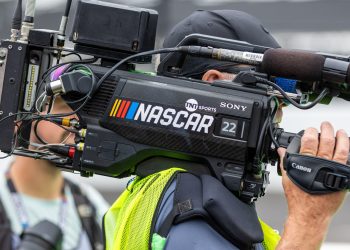
In areas facing severe drought conditions, solutions might include water conservation, harvesting rainwater or desalination. Alternatively, one could build a racetrack and have NASCAR come to town.
There is no rainmaker in all of sports like NASCAR, which seems to travel each week from downpour to downpour. Numerous races this season have been affected by rain, even the preseason Clash from typically sunny Southern California. (That race is moving to North Carolina next year, where bad weather is far more common.)
There are few fixes for the unpredictability of Mother Nature, but one that is commonly suggested is to simply move the races up a few hours — perhaps to the 1 PM ET starts that were once traditional. Earlier starts would provide much greater runway to dodge rain, especially as several tracks lack lighting — thus creating a sunset deadline by which to finish racing.
When the Cup Series arrived in Chicago for its second-annual street race last month, the weather on Sunday was immaculate, at least until the race started at around 4 PM local time. Had it begun at 1 PM ET (Noon locally), it may well have finished ahead of the persistent downpour that marred the day. Even if it had not, enough laps would have been completed that the race could have run to its conclusion when it resumed later in the evening. Instead, the race was shortened to meet the 8:20 sunset deadline. (Typically, a race would simply conclude on Monday — as was the case this past weekend at Michigan — but Chicago was not going to turn over its city streets for a third-straight day.)
Similarly, Michigan this past weekend would have been impacted by rain even had it begun earlier, but the crucial difference an earlier start time would have made is that enough laps could have been run to potentially avoid a Monday finish. Beyond the impact on the in-person audience, the television audience is also greatly reduced when a race has to be postponed to another day. The Sunday portion of the Michigan race, 51 laps from from 4:56-5:41 PM ET, averaged a 1.2 rating and 2.11 million viewers on USA Network Sunday. The Monday resumption averaged about half of that, with a 0.6 and 1.11 million.
So why does NASCAR stay with mid-and-late afternoon starts? “I’d say it’s a balancing act, like almost everything that we do here,” NASCAR Senior Vice President, Broadcasting & Innovation Brian Herbst told Sports Media Watch on Wednesday. Beyond having to balance the concerns of the tracks, the teams, the drivers, the sponsors and the media partners, NASCAR must also balance two separate groups of fans: those in attendance and those watching on television.
The impact of an earlier start on that television audience is not trivial. For every hour a race is moved back, NASCAR estimates a five percent viewership hit. “If you look at it purely from a data perspective, you’re averaging 3 million viewers per event. That 10 percent from 3:00 pm to 1:00 pm is about 300,000 viewers, just broadly speaking,” per Herbst. A recent example is the annual Cup Series race from Indianapolis Motor Speedway, which gained about 500,000 viewers after moving from a 1 PM ET start in 2021 to a 2:30 PM start in 2022. “If the overarching goal is to drive fan interest in the sport and make sure there’s as many people that are paying attention to your sport as possible, trying to get those 300,000 extra viewers on a typical Sunday is important.”
NASCAR has already made some small moves toward balancing the needs of television with the realities of the weather forecast. For racetracks without lights, start times have generally moved up a half-hour from 3:00 to 2:30 PM ET the past two seasons, a way of providing some extra buffer without sacrificing much in the way of viewership. Though that was not early enough to help at Michigan this past weekend, a half-hour is not nothing when it comes to getting a race in.
Sometimes, NASCAR’s media partners will prefer an earlier start to accommodate their other properties; for instance, a 2 PM ET start for Talladega in October to ensure that NBC is able to air its nightly newscast at 6:00. For the most part, however, the trend is toward later start times due to the impact on viewership. Do not expect that to change with the additions of TNT and Amazon Prime next year. The networks, Herbst said, “like to see numbers — and so would we, frankly, on the league side — where we’re drawing in the biggest audience possible.”
Ultimately, even if a race starts early enough to more easily accommodate a weather delay, a rain-impacted race is still a rain-impacted race. In moving up its start times, NASCAR would be guaranteeing itself a smaller audience each week in order to merely lessen – not prevent – the negative impact of a rain-delay. The cost/benefit analysis simply does not work in favor of earlier starts, especially as rain-impacted races are still relatively rare.
A different change may be easier to accomplish. Giving voice to another common complaint among viewers, driver and team owner Denny Hamlin said this week that in his capacity as an owner, he would be willing to accept less television money in order to have more consistent start times. “NASCAR is wanting to get whatever dollar, every penny of media that they possibly can, because that’s money that goes in their pockets. For us as teams … we’re so sponsorship based, so when you take us and you put us on all these other networks and all these other start times, it gets confusing.” IndyCar, he noted, will be on only one network next season — taking less money to get consistent exposure every single week on the FOX broadcast network.
NASCAR is already moving in that direction on its secondary Xfinity Series, which starting next month will move exclusively to Nexstar’s CW. Not only will all races air solely on one over-the-air network, but for at least this year, the start times will be consistent at 4:00 or 7:30 PM ET. That level of consistency would be simply impossible for the Cup Series, which has four different media partners and six different networks to work with, but Herbst signaled that NASCAR is open to a more consistent Cup schedule, particularly for its summer races.
The most important schedule change for NASCAR is, of course, fully out of its control — a little luck with Mother Nature would go a long way.