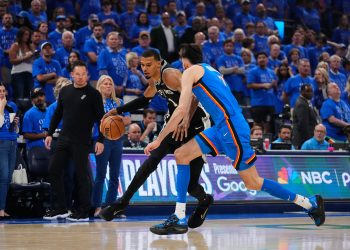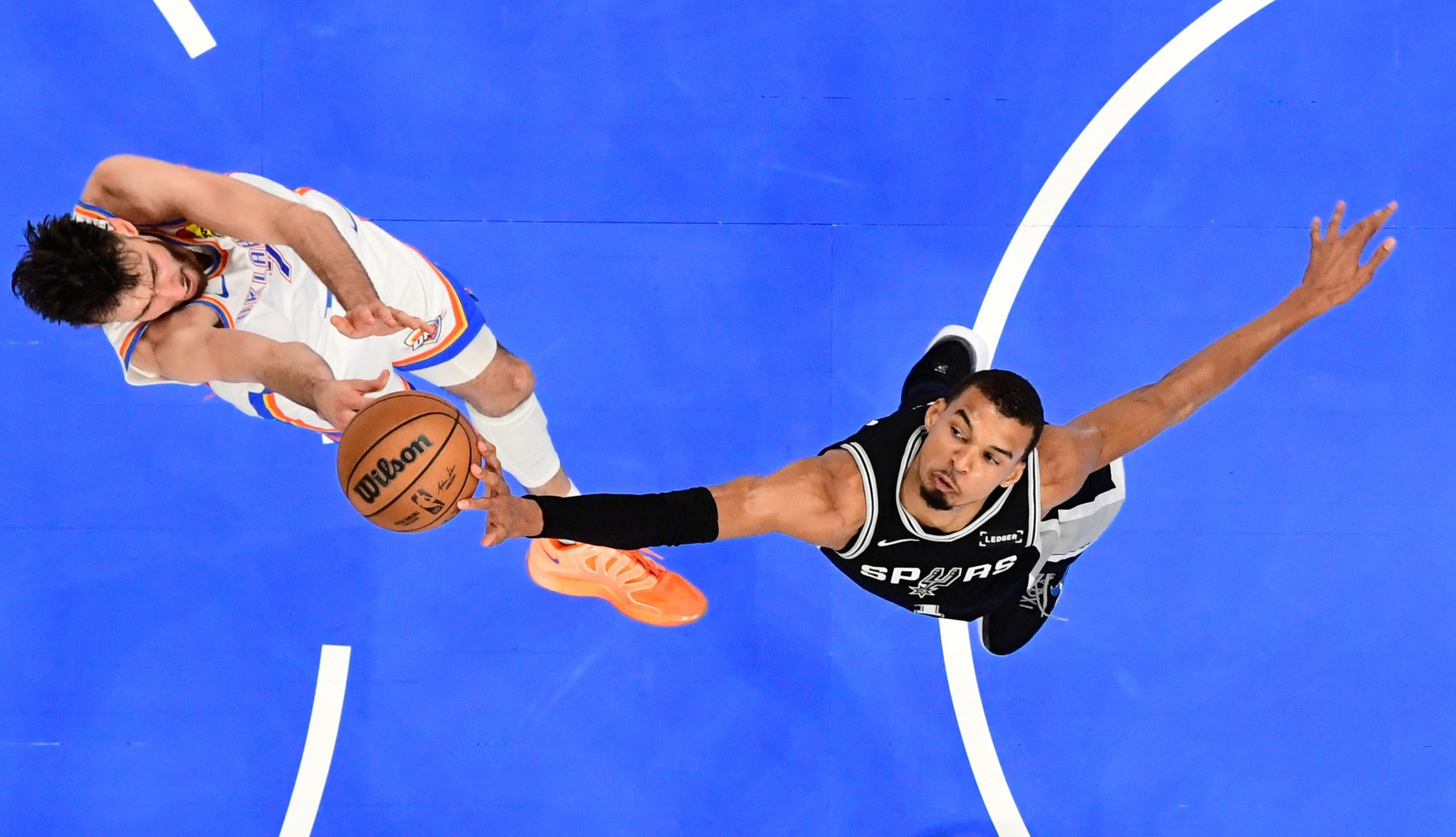
One of the most anticipated NBA playoff series in years will end with the league’s first conference final Game 7 on broadcast television in nearly a quarter-century. What kind of audience can one expect for Spurs-Thunder Game 7?
Through five games, the Spurs-Thunder Western Conference Finals was averaging 9.74 million viewers on NBC across Nielsen and Adobe Analytics, surpassing last year’s Nielsen-only five-game average for the Thunder-Pacers NBA Finals on ABC (9.18M). (NBC’s position is that because Nielsen does not track its streaming viewership, its combined Nielsen + Adobe audience figures are comparable to the Nielsen-only figures of other networks.)
While that 6% margin is within the range that can be explained by Nielsen methodological changes, it is no small feat for a conference final to rank close enough to an NBA Finals for methodology to matter. Last year’s five-game Thunder-Timberwolves Western Conference Finals averaged 5.59 million on ESPN/ABC, and even the stronger-performing six-game Pacers-Knicks East Finals on TNT Sports finished shy of the seven million mark (6.96M). Those figures paled in comparison to even the historically low audiences of Thunder-Pacers.
What is the difference-maker this year? To start with, Spurs-Thunder is the only the second conference final to air entirely on broadcast television, following the Spurs’ four-game sweep of the Trail Blazers on NBC in 1999 (and only one of those four games aired fully in primetime). Historically, the only NBA series to air entirely on broadcast television have been NBA Finals. It may be no surprise that NBA Finals-level exposure is leading to NBA Finals-level audiences.
Realistically, that is too simplistic an explanation. Would Spurs-Thunder be averaging this kind of audience if every game was airing on ABC? Would NBC be averaging the same kind of viewership had it gotten the Knicks’ four-game sweep of the Cavaliers instead? Ultimately, this year’s conference final has benefited from an ideal pairing of matchup and network.
Start with NBC, which on Saturday will conclude its first NBA season since 2001-02. Other than TNT, no network has ever been as associated with the NBA as NBC, whose blend of marketing and storytelling was perfectly suited for the rise of Michael Jordan in the 1990s. For more than two decades, the standard set by the NBA on NBC was largely abandoned by the network that replaced it, ABC. Now, one year into its return as the league’s “B” partner, NBC has picked up the mantle from the 1990s and paired it with the ‘big event’ approach it developed for “Sunday Night Football.” The result has been a white glove treatment the NBA has not enjoyed for nearly a quarter-century.
That includes the production values for which NBC is often praised. From lipreading Victor Wembanyama — in particular after being ejected in Game 4 against Minnesota and then heading to the bench in Game 5 against Oklahoma City — to catching nuns blessing Luke Kornet, to queuing up a postgame shot of a thunderstorm over the San Antonio skyline after a Thunder victory, NBC has an eye for detail that captures the subtleties that add color to a game.
More than anything, NBC has committed to the NBA like no broadcast network previously. Even in its previous run with the NBA, NBC’s coverage was mostly limited to weekends after Christmas until the late portion of the playoffs (and that was far greater exposure than CBS beforehand and especially ABC afterward). NBA on NBC 2.0 airs games all season-long, mostly in primetime, providing a cable-level of tonnage on a broadcast network. Saturday will mark the 67th and final NBA telecast window on NBC this season (counting its “Coast 2 Coast Tuesday” regional games as one window). After it acquired rights from NBC in 2002, it took ABC two and a half seasons before it carried its 67th window, and that is including two NBA Finals.
The reason people tune into watch sports is the game, with everything else secondary. But if one is trying to figure out why NBC in year one was the most-watched broadcaster during the regular season and during the playoffs, the combination of storytelling, attention to detail and — most of all — commitment would seem to be a passable explanation.
But the matchup deserves credit as well. Would NBC be drawing this well had it gotten the Knicks’ four-game sweep of the Cavaliers in the Eastern Conference Finals? There is only so much storytelling one can do to make nearly 40-point sweep-clinching rout appear interesting.
It has been many years since the NBA delivered a matchup as attractive as Spurs-Thunder, probably since the Warriors and Cavaliers met in four-straight NBA Finals. The teams had the two best records in the NBA, a first for a conference final since Spurs-Warriors in 2017 (a series marred by Zaza Pachulia). Even most NBA Finals do not feature teams of such quality, as the series is the first matchup of teams who won 62 or more regular season games since the 1998 NBA Finals. That also holds true on an individual level, with the matchup marking the first conference final since 2009 to pit the MVP (Shai Gilgeous-Alexander) against the Defensive Player of the Year (Wembanyama).
One of the most important factors making a series attractive for television is if it was foreshadowed throughout the season. The Spurs and Thunder have seemed destined for a playoff meeting all season, going as far back as their first matchup in December — an NBA Cup semifinal in which San Antonio pushed 24-1 Oklahoma City off of the 2016 Warriors’ 73-win pace. The teams met in a Christmas Day matchup that finished as the most-watched game of the regular season.
None of the above would matter if the series had been a letdown, but the series has been competitive — particularly by the lopsided standards of recent conference finals. Spurs-Thunder is the only conference final in the past four years to have been tied 1-1 or 2-2. Sure, some of those other series ended up competitive (the Celtics came back from 0-3 down to force a Game 7 in 2023), but it is hard to build momentum for a series that is 2-0, 3-1 or worse yet 4-0.
Sometimes a competitive series is not enough. Last year’s Thunder-Pacers Finals was 1-1, 2-2 and then 3-3, but viewership simply never built for that series until the Game 7 pop. Realistically, the viewership for Spurs-Thunder has not been all that different, it is just that expectations are far lower for a conference final than for an NBA Finals. 9.7 million viewers for a conference final is historic territory; so too is 9.2 million for an NBA Finals, but in the other direction.
A conference final (or League Championship Series) Game 7 is traditionally one of the biggest possible draws in its respective sport. The last one in the NBA, Heat-Celtics in 2023, had an audience of 12.0 million boosted by Memorial Day and intrigue in the Celtics’ comeback attempt. (The same teams met the prior year in front of a lesser audience of 9.9 million.)
The last conference final Game 7 on broadcast television was Lakers-Kings in 2002, a series that remains one of the most memorable in NBA history. Game 7, on a Sunday night, averaged 23.8 million — still the second-largest conference final audience record. (Pacers-Bulls Game 7 in 1998, which could have been Michael Jordan’s final game, holds the top spot at 30.6 million.) Most other conference final Game 7s have been in the teens viewership wise, and that is almost certainly where this year’s game will end up.
Given viewership for this series has been pacing ahead of last year’s Pacers-Thunder finals, one might be tempted to suggest a Game 7 audience north of the 16.6 million that series averaged in its Game 7. But that was on a Sunday night. While there is recent precedent for a massive Game 7 audience on a Saturday night — last year’s Dodgers-Blue Jays World Series Game 7 — it remains the case that Saturday is the least-watched night of the week. Perhaps there are certain games so attractive that the day of the week no longer matters, and perhaps Spurs-Thunder is one of them, but conference final Game 7s have historically gotten less of a lift on Saturday nights than on other nights of the week.
Typically, viewership grows about 40-60% from Game 6 of a conference final to Game 7. The Monday night Heat-Celtics in ’23 increased 38%, the Sunday night Celtics-Heat in ’22 increased 37% — and when both conference finals went seven in 2018, the Sunday night Cavaliers-Celtics increased 64% from Game 6 and Warriors-Rockets increased 56% the following night.
But in 2012, when the Celtics and Heat met in a Game 6 at the height of the “Heatles” era, Game 7 viewership increased only 21% from Game 6. And in 1993, viewership for Game 7 of Sonics-Suns actually declined 13% from Game 6. What do those games have in common? They were the two previous conference final Game 7s on a Saturday.
Realistically, much has changed in Nielsen measurement from 2012, much less 1993, and there is little question that Saturday nights are less of a drag in the out-of-home era. But even in the wake of last year’s historic audience for Game 7 of the World Series, there is not enough evidence yet that viewership can reach the same ceiling on Saturday night as on any other night of the week.
Any audience north of 16 million would surpass every conference final Game 7 on cable, a run of eight games between 2005-23. Top 16.6 million and Game 7 will be the most-watched NBA game period since COVID. It would take at least 17.4 million for this year’s game to break into the top five most-watched conference final Game 7s. Realistically, just beating the most-recent Western Conference Finals Game 7 — Warriors-Rockets on TNT in 2018 (14.8M) — is the most attainable goal.
Prediction
NBC and the NBA simply could not have asked for a better outcome than the Spurs and Thunder playing a full seven-game series.
— NBA Western Conference Finals: Spurs-Thunder Game 7 (8p Sat NBC, Peacock). Prediction: 15.2 million.